

Restaurant Smoke Restoration Example: The Real Work
A restaurant fire can be small enough that the building remains standing and large enough to close the operation for days or weeks. This restaurant smoke restoration example shows why wiping visible soot from walls is not a complete recovery plan. Smoke moves through supply vents, settles on ceiling surfaces, penetrates upholstery, and leaves odor-causing residues in places customers and staff may never see.
For a restaurant owner or property manager, the immediate challenge is bigger than appearance. The space must be evaluated for contamination, cleaned with methods appropriate for food-service environments, and returned to a condition that supports a safe, credible reopening. The right scope depends on the fire source, the type of materials burned, the affected areas, and requirements from insurers and local authorities.
Restaurant Smoke Restoration Example: A Typical Scenario
Consider a casual dining restaurant where a small grease fire started on the cook line after service. The suppression system activated quickly, preventing major structural damage. However, smoke traveled beyond the kitchen through the dining room, service corridor, restrooms, storage areas, and HVAC system.
At first glance, the damage appeared limited. There was visible soot above the cooking area, a sharp odor in the dining room, and residue on several nearby walls. A closer inspection found a more extensive problem: fine soot particles had settled on ceiling tiles, light fixtures, booth upholstery, window treatments, and hard surfaces. Air movement had also carried odor and particulate matter into ductwork.
This distinction matters. Cleaning only the kitchen would leave the restaurant with lingering odors and possible cross-contamination concerns. Cleaning only what is visibly blackened may also allow residues to reappear, especially on porous surfaces or in areas affected by HVAC airflow.
The First 24 Hours Set the Direction
Before restoration begins, the property should be stabilized. If fire officials have not released the site, no cleaning or entry should proceed beyond necessary emergency measures. Once access is approved, the restoration team documents conditions, identifies affected materials, and determines whether water from firefighting or suppression systems created a secondary moisture concern.
In this scenario, the initial assessment separates the restaurant into work zones. The cook line and adjacent prep areas are treated as heavily affected. The dining room is moderately affected because smoke entered through open pass-through areas and air circulation. The dry storage room is lightly affected but still requires inspection because smoke odor can be absorbed by packaging, paper goods, and porous inventory.
This is also when contents decisions are made. Food, open consumables, and some paper products may need to be discarded when contamination is suspected. Sealed items are not automatically safe or unsafe - their disposition should follow inspection findings and applicable health guidance. A professional restoration scope should never treat food safety as an afterthought.
Containment Prevents a Bigger Cleanup
Restoration work can disturb soot if it is performed carelessly. Dry particles may become airborne and settle in previously unaffected rooms. For that reason, technicians establish containment between heavily affected kitchen areas and cleaner sections of the property before detailed cleaning begins.
Negative air equipment, HEPA filtration, and controlled work pathways help reduce the spread of airborne particulate. This is particularly valuable in a restaurant, where grease, soot, and odor residues can migrate onto tables, menu displays, beverage stations, and customer-facing finishes.
Containment is not a one-size-fits-all process. A small, isolated fire may require limited barriers and localized filtration. A fire that traveled through ceilings or HVAC pathways may call for a wider controlled area and more extensive air cleaning. The goal is to protect unaffected spaces while allowing restoration to proceed efficiently.
Removing Soot Requires the Right Sequence
Soot is not ordinary dust. Depending on what burned, it can be dry and powdery, sticky and greasy, or firmly bonded to surfaces. Wet wiping the wrong soot before dry removal can smear it deeper into paint, grout, fabric, and textured finishes.
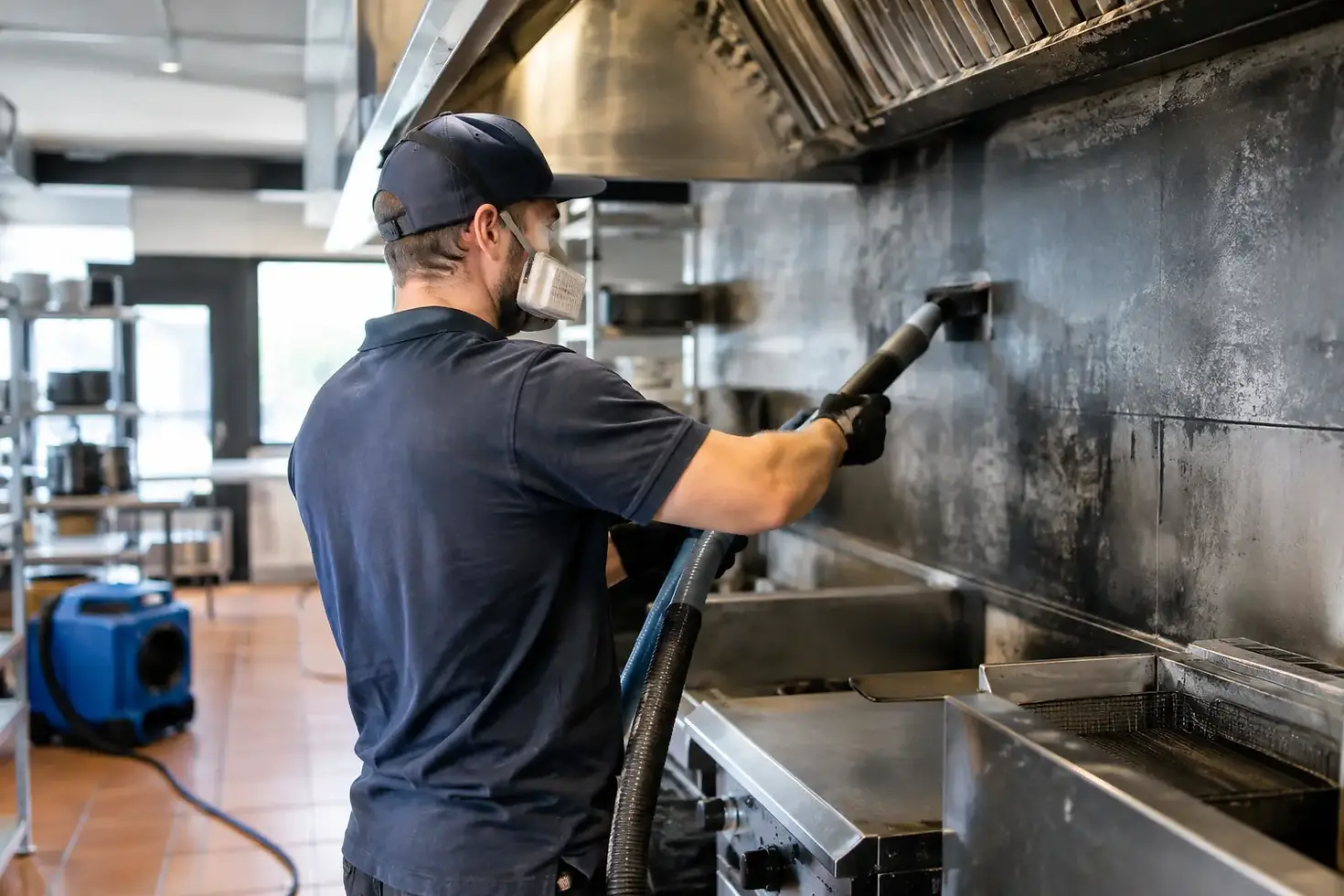
In the restaurant example, technicians begin with dry particulate removal using specialized HEPA vacuuming and dry-cleaning methods. They then use surface-specific cleaning agents and techniques for walls, ceilings, stainless steel, tile, glass, fixtures, and nonporous equipment exteriors. Kitchen surfaces require particular attention because residue can build up in seams, behind equipment, and around exhaust-adjacent areas.
Porous and delicate materials require a different decision process. Upholstered booths, drapes, acoustic panels, ceiling tiles, and decorative woodwork may be restorable, but not always. The decision depends on the depth of contamination, the material’s condition, the expected cleaning result, and whether odor can be reliably removed. Replacement can sometimes be more practical than repeated treatment, especially for low-cost, heavily contaminated items.
Cleaning should also follow a disciplined top-to-bottom sequence. Ceiling areas, lighting, walls, and elevated fixtures are addressed before floors and lower surfaces. Otherwise, particles removed overhead can settle onto work that has already been completed.
Odor Control Is More Than Adding a Fragrance
The odor after a restaurant fire comes from smoke particles and gases deposited on materials. If the residues remain, odor often returns when the building warms up, humidity rises, or HVAC equipment starts moving air again. Fragrance products may temporarily mask the problem, but they do not remove the source.
In this example, odor control begins after source removal. Cleaned surfaces are evaluated, and remaining odor reservoirs are identified. These may include insulated ductwork, carpeting, booth cushions, wall cavities, ceiling voids, and soft decorative materials.
Professional odor treatment may involve thermal fogging, hydroxyl treatment, ozone treatment, or other methods chosen for the conditions and occupancy requirements. Each has trade-offs. Some treatments require the area to be unoccupied for a defined period, while others are better suited to specific odor types or materials. Equipment should be selected as part of a complete restoration plan, not used as a substitute for physical cleaning.
HVAC Cleaning Can Determine Whether the Odor Returns
The HVAC system deserves focused attention after smoke exposure. When a system operates during or after a fire, it can distribute fine particles and odor throughout the facility. Reopening the restaurant without evaluating affected ducts, air handlers, registers, filters, and coils can undermine otherwise thorough restoration work.
For this restaurant, the system is inspected before normal operation resumes. Filters are replaced, accessible components are cleaned as needed, and ductwork is assessed for soot deposition. Air ducts that contain smoke residue should be professionally cleaned with appropriate collection and filtration equipment rather than simply sprayed with deodorizer.
The extent of HVAC work depends on the system design and the fire’s location. A fire contained beneath a well-functioning hood may produce a different scope than a fire that sent smoke into return-air pathways. Documentation of the inspection and cleaning process is useful for owners, insurers, and facility records.
Preparing for Reopening Without Cutting Corners
A restaurant reopening plan should be based on completed restoration work, not just the disappearance of visible soot. Before reopening, management should verify that food-contact surfaces and food-preparation areas have been appropriately cleaned and sanitized, that damaged inventory has been addressed, and that odor has been evaluated under normal operating conditions.
The property may also need approval or guidance from the relevant fire, health, building, or insurance authorities. Those requirements vary by location and the nature of the incident. A restoration provider can support documentation and cleaning, but it should not replace the authority of inspectors or the insurer’s adjuster.
In the example, the restaurant schedules a final walkthrough after the HVAC system has operated. This step reveals whether any residual odor appears during normal airflow and whether surfaces near vents require additional detail cleaning. Staff return only after the work areas are clear, the kitchen is ready for service preparation, and management is satisfied that the guest experience will not be compromised.
Why Restaurants Need a Specialized Restoration Scope
Restaurants combine grease, heat, porous furnishings, high-touch surfaces, ventilation systems, and food-safety responsibilities in one setting. That makes smoke recovery more complex than a general janitorial cleanup. A rushed approach may create a clean-looking dining room while leaving odor, soot, or moisture issues behind equipment and inside air-distribution systems.
Prochem Bahamas provides restorative cleaning, fire and smoke damage remediation, odor control, and HVAC cleaning under one roof, helping restaurant operators coordinate a more complete response when a fire disrupts operations. With the right assessment, equipment, and cleaning sequence, recovery can protect the property, support a safer workplace, and help preserve customer confidence when the doors reopen.
After any smoke event, treat the first inspection as a decision point, not a formality. A clear, documented scope built around the restaurant’s actual conditions is the most reliable way to move from disruption to a well-prepared reopening.


Comments